Call for Papers
The 7th International Conference on Non-Professional Interpreting and Translation (NPIT7) invites exploration of multilingual practices in a diversity of spaces and times within migratory, diasporic, and globalized contexts. Non-professional translation and interpreting take place in varied urban and rural spaces, both public and private, such as schools, hospitals, museums, public service departments, as well as political, religious, or cultural institutions. In almost every region of the world, NGOs and state departments often rely upon multilingual agents who are not necessarily professional(ised) translators and/or interpreters to enable communication. Historically, multilingual practices have been inherent in most empires since antiquity, whether forced, tacit, or openly fostered. In today’s globalised world, acts and products of nonprofessional translation, interpreting, mediation, or any other type of multilingual practice enable communication across diverse expertise fields—from public administration, trade, economy, industry, healthcare, social services, education and science to arts, music, and literature. In these contexts, multilingual agents occupy varying positions and reputations depending on the cultural, social, and political frameworks surrounding nonprofessional interpreting and translation. They may face discrimination, marginalization, neglect, or suppression, but can also receive acknowledgment, celebration, and respect. However, it should not be forgotten that today human translators and interpreters, professional or non-professional, are often no longer engaged and multilingual communication is managed via translation apps and similar tools, assisting or even replacing human agents. The reasons are manifold, spanning a political denial of human translation and interpreting to a widespread, sometimes naive and illusory, but often politically and economically supported, technological faith. This conference would certainly benefit from a closer analysis of these reasons.
Building on this perspective, NPIT7 invites all participants to illuminate the dynamic relationships and societal effects of multilingual agents, with particular attention to the materialities, artefacts, and technologies that shape their multilingual practices. In so doing, the historical and current situatedness of non-professional(ised) translating and interpreting practices can be brought to the fore. Furthermore, this perspective calls for rethinking the basic dichotomy of “professional/non-professional”. If we discuss non-professional translation and interpreting as multilingual practices, it becomes obvious that further binary denominations, conventionally applied for the distinction between professional and non-professional, like remunerated/non-remunerated, qualified/non-qualified or commissioned/voluntary, may also be questioned and unsettled. This conference aims to encourage researchers and practitioners alike to view interpreters and translators as straddling a liminal position determined by geopolitical, socio-economic, socio-professional, and/or technological factors. We invite participants to examine translation and interpreting practices not merely through the professional/non-professional divide, but in relation to their role within specific domains—encompassing public administration, trade, economy, industry, military, crisis and disaster management, healthcare, social services, education, science, the arts, music, or literature. This is a perspective that has enormous potential to deepen and diversify our understanding of professionality/professionalism and to enable an inter- and even paraprofessional and inter- and transdisciplinary approach to multilingual practices. These practices also display a multitude of motives and functions ranging from conventionalized and engaged to the informal. Research and practice on non-professional interpreting and translation would benefit significantly from describing the forms, motivations, and functions of various human agents and nonhuman actors engaged in multilingual practices across different spaces and times.
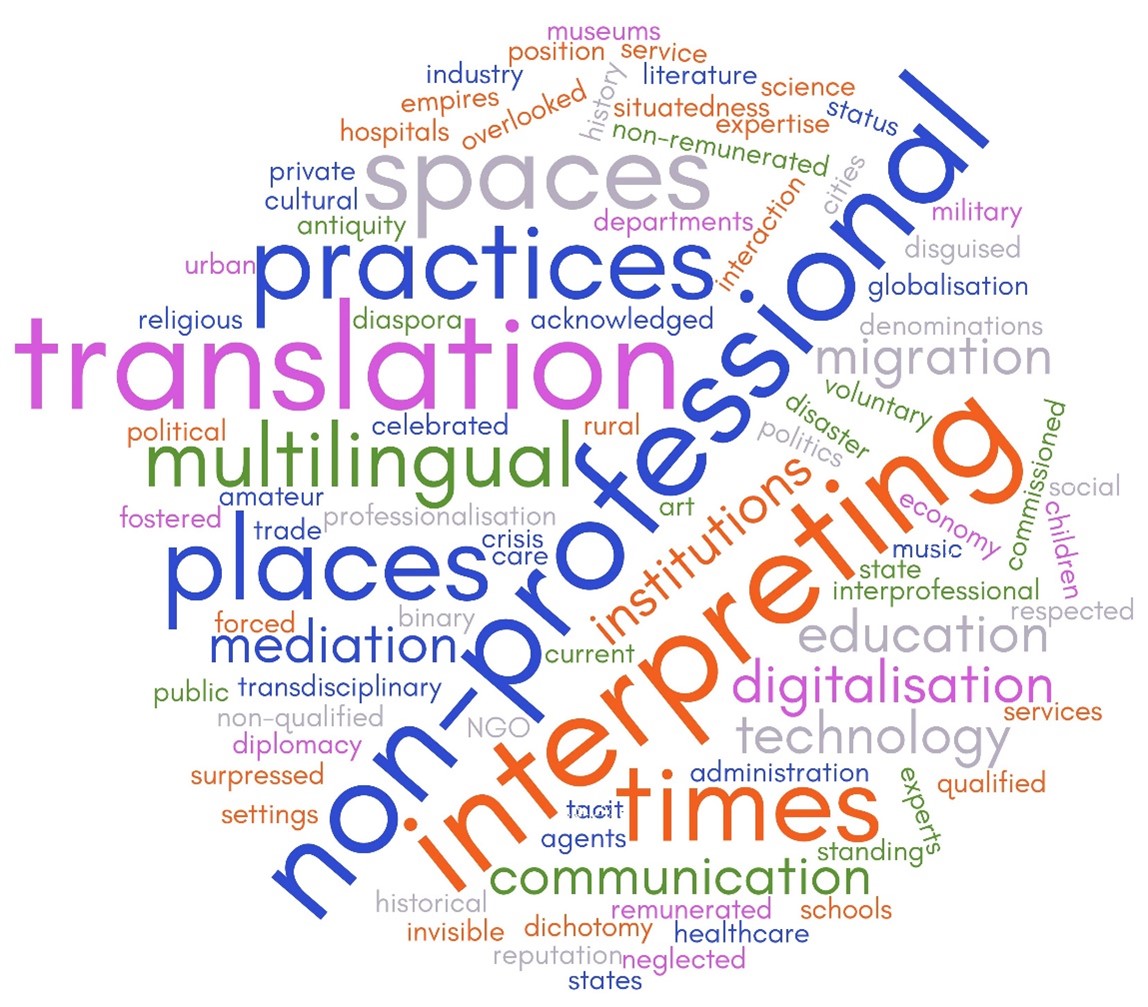
The 7th International Conference on Non-Professional Interpreting and Translation (NPIT7) Organising Committee invites proposals for presentations on any theoretical, empirical, and/or methodological aspect of research related to the conference theme. Subjects for papers and other formats may include but are not limited to concepts and issues in the following word cloud which was created on the basis of our CfP.
Time and place
The conference will take place on 14 – 16 May 2026 at the University of Graz, Austria.
Guest Speakers and Round Table
- Katharina Brizić (University of Freiburg)
- Rebecca Tipton (University of Manchester)
- Roundtable: NPIT in Austria – Research and Practice
Submissions
Three categories of proposals will be considered: (i) individual presentations, (ii) panels, and (iii) alternative formats. The official conference language is English for all proposals. Abstracts will be double blind peer-reviewed and evaluated by the NPIT7 Scientific Board and the local organisers. All contributions will be assessed based on their relevance to the conference theme as well as their theoretical background and research design.
Proposals for individual presentations
Each paper presentation will be scheduled for 20 minutes, plus 10 minutes for discussion. For individual presentations, submissions should include: a max. 300-word abstract, a short bionote, including name, affiliation and email address and a max. of 5 keywords covering subject, methodology and theoretical framework(s). Submissions open July 1st 2025.
Proposals for panels
Panels will consist of a collection of up to four paper presentations given within a 120-minute timeframe. Panels will be reviewed en bloc and based on the abstracts provided by the panel convenors. Panel organisers are required to submit the following:
- A title and a general overview abstract (max. 500 words, describing the whole panel)
- The name(s) of the convenor(s) and a list of invited contributors, including names, affiliations, email addresses, and short bionotes
- A maximum of 5 keywords covering subject, methodology and theoretical framework(s)
- All individual abstracts (max. 300 words each, including references)
- Moreover, panel convenors are also required to chair their panel and ensure that all speakers register for the NPIT7 by the deadline for speaker registration.
Submissions open July 1st 2025
Proposals for alternative formats
We welcome submissions of alternative formats. These will be given a time slot of max. 120 minutes. Possible formats could be: fish bowl discussions, workshops focusing on applications and practice, research dating (matching and exchange meetings for research collaborations), roundtables between practitioners and researchers, methodology workshops, world cafés, future workshop, markets of opportunities as well as creative literary, artistic, or dramatic performances related to the conference theme. We are also open to suggestions for other alternative formats. Convenors are required to submit the following:
- A title and a general overview abstract (max. 500 words, including examples and references)
- A description of the format (max. 300 words)
- The name(s) of the convenor(s), including affiliation, email address and a short bionote
- A list of invited contributors (name, affiliation, email address, short bionote)
- Where necessary, individual abstracts (max. 300 words each, including references)
- A maximum of 5 keywords covering subject, methodology and theoretical framework(s)
Submissions open July 1st 2025
Important dates, deadlines, and contact information
- Submission of proposals: 01 July – 20 September 2025 The abstract submission deadline has been extended to 5 October 2025, 23:59 CEST.
- Notification of acceptance: 20 December 2025
- Registration: 15 January – 28 February 2026
For other inquiries, please contact the local organisers at npit7(at)uni-graz.at